Ballon d’Or Website Blunder: Kane, Mbappé and Yamal Named Winners Before Ceremony
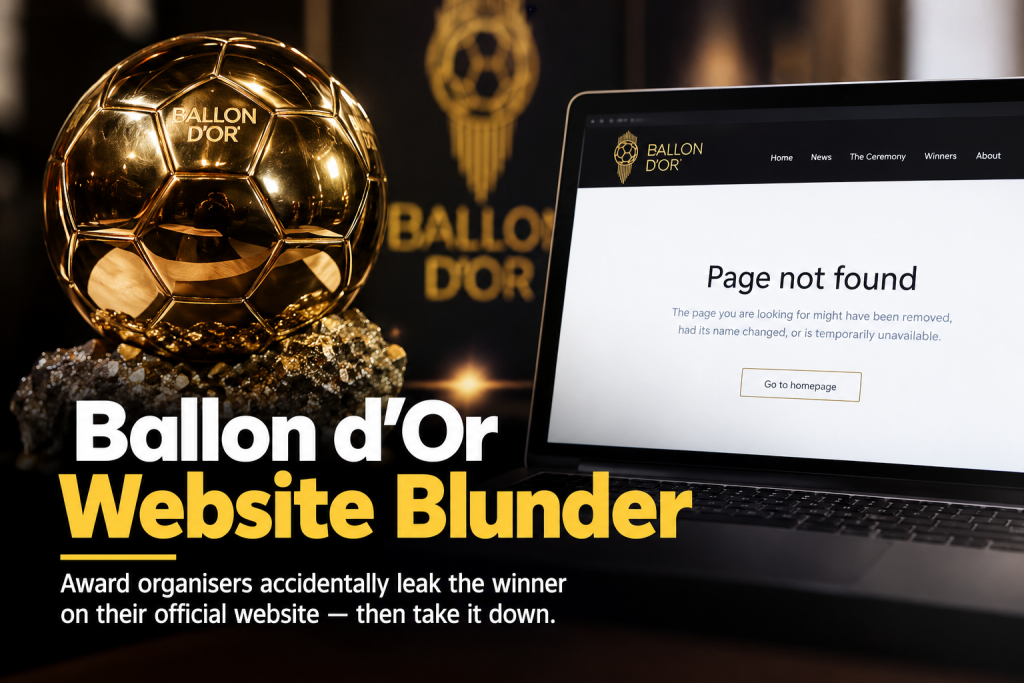
The 2026 Ballon d’Or ceremony was overshadowed by an extraordinary online publishing error after the award’s official website briefly published separate articles declaring Harry Kane, Kylian Mbappé, and Lamine Yamal as the men’s winner.

The incident occurred on Monday, October 26, just hours before the ceremony at London’s Palladium Theatre, triggering widespread speculation among football fans about whether the winner had been revealed prematurely.
The articles were subsequently removed, but screenshots and reports spread across social media, turning the website error into one of the major talking points surrounding football’s most prestigious individual award.
The confusion eventually ended when Bayern Munich and England striker Harry Kane was officially announced as the 2026 men’s Ballon d’Or winner, finishing ahead of Mbappé and Yamal.
Reports from The Independent and other outlets detailed how the three separate winner articles appeared before the official announcement.
How Did the Ballon d’Or Website Error Happen?
In the hours before the ceremony, visitors discovered articles on the official Ballon d’Or website that appeared to confirm different winners.
One article named Kane as the recipient of the award. Other articles described Mbappé and Yamal as winners.
The conflicting reports immediately raised questions about whether the result had been leaked or whether the website had published content prematurely.
According to ESPN’s reporting, the likely explanation was that the organisers had prepared multiple articles in advance so they could publish the appropriate announcement quickly after the result became official.
However, the articles appeared before the winner had been announced, and their publication created confusion around the ceremony.
The pages were taken down, but the incident had already attracted considerable attention.
It remains important to distinguish the confirmed publishing error from speculation about the organisers’ internal processes. The appearance of multiple articles did not mean that three players had won the award.
Read: https://www.tulanegrad.com/why-psg-beat-barcelona/

Harry Kane Was the Official Winner
Despite the confusion, the official result was clear: Harry Kane won the 2026 Men’s Ballon d’Or.
The Bayern Munich striker finished ahead of Kylian Mbappé in second place and Lamine Yamal in third.
Kane’s remarkable campaign provided the sporting context for his victory. He scored 73 goals for club and country during the 2025/26 season and helped Bayern secure major domestic honours.
He also scored six goals for England at the 2026 FIFA World Cup as the national team reached the semi-finals.
The result made Kane the first Englishman to win the men’s award since Michael Owen in 2001.
The historic achievement was the main sporting story of the evening, even as the publishing error drew attention away from the ceremony’s central purpose.
Why Did the Incident Generate So Much Attention?
The Ballon d’Or attracts intense interest because its winner is debated by supporters, journalists, former players, and analysts throughout the season.
In 2026, Kane, Mbappé, and Yamal were among the leading contenders, each bringing a different case to the discussion.
Kane had an outstanding goalscoring season and contributed to Bayern’s success.
Mbappé remained one of the leading attacking players in world football, while Yamal continued his rapid rise with Barcelona.
The unexpected appearance of three separate winner announcements gave fans another reason to debate the award.
It also demonstrated how quickly an apparent leak can spread online when it concerns a major sporting event.
For football publishers and social media users, the episode highlights the importance of verifying reports against official announcements before presenting them as facts.
A Difficult Moment for the Award Organisers
Major award ceremonies depend on accurate communication, careful scheduling, and a clear announcement process.
Publishing conflicting winner articles before the ceremony undermines the suspense surrounding the result and can create unnecessary uncertainty for fans and journalists.
The incident also raises questions about content-management workflows, publication scheduling, and the checks used to prevent embargoed material from becoming public too early.
Preparing articles for multiple possible winners is a normal editorial practice for major events. The challenge is ensuring that only the correct article becomes publicly accessible at the appropriate time.
Although the mistake did not change the official result, it became a significant part of the story surrounding the 2026 ceremony.
Lamine Yamal and Mbappé Still Had Reasons to Be Recognised
The publishing error should not overshadow the performances of the other leading contenders.
Mbappé’s second-place finish confirmed his place among the world’s leading players, while Yamal completed another major milestone by finishing third and winning the Men’s Young Talent of the Year award for the third consecutive year.
Their positions underline the competitive nature of the Ballon d’Or and the different ways players can build a case for individual recognition.
Yamal’s continued emergence is particularly significant because he is competing with established superstars while still developing his career.
Mbappé, meanwhile, remains a prominent contender for future editions of the award.
Their performances ensure that the discussion about the next Ballon d’Or race is likely to begin well before the next ceremony.
The Bigger Lesson for Football News
The Ballon d’Or website blunder is a reminder that even major sporting organisations can experience publishing errors.
In the digital news environment, speed matters, but accuracy remains essential. A headline appearing on an official-looking webpage can quickly be interpreted as confirmation, even when the information has not been formally announced.
Readers should verify major sporting claims through the official award announcement and established news organisations.
Publishers should also distinguish between confirmed results, reports about possible leaks, and speculation about how an error occurred.
The incident generated attention because of the players involved and the significance of the award. Yet the key facts remain straightforward: three separate winner articles appeared prematurely, the articles were removed, and Harry Kane was subsequently confirmed as the winner.
Conclusion
The 2026 Ballon d’Or ceremony will be remembered for Harry Kane’s historic triumph, but the official website’s premature publication of articles naming Kane, Mbappé, and Yamal as winners created an unexpected controversy.
Kane ultimately received the award after an exceptional season, while Mbappé finished second and Yamal placed third.
The incident highlights the importance of accurate publishing and responsible reporting, particularly during major sporting events when fans are eager for immediate updates.
For now, Kane’s achievement remains the defining sporting outcome of the evening, while the website error has added an unusual chapter to the history of the Ballon d’Or.