Football Betting Tips 1X2: How to Predict Home Wins, Draws and Away Wins
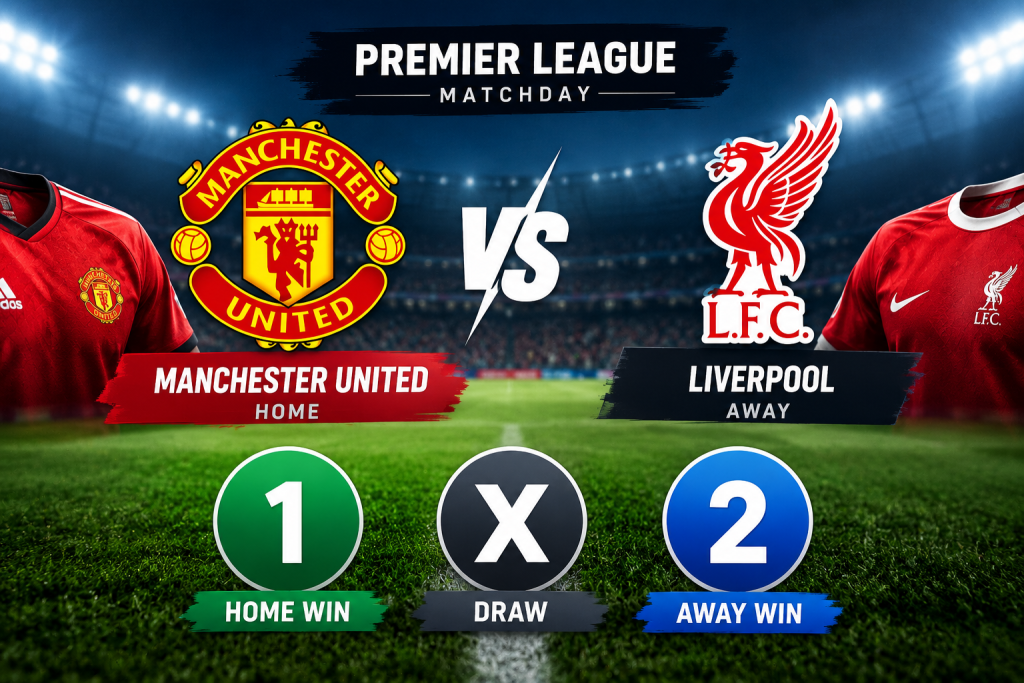
Football betting tips 1X2 are popular among football fans who want to analyse match outcomes before placing a wager. The 1X2 market gives you three possible selections: a home win (1), a draw (X), or an away win (2). Understanding these options, studying team performance, and comparing odds can help you make more informed betting decisions.

Whether you follow the English Premier League, UEFA Champions League, La Liga, Serie A, or other football competitions, learning how the 1X2 market works is an important step towards understanding football betting.
In this guide, we explain what 1X2 means, how to analyse fixtures, how to interpret odds, common betting mistakes to avoid, and how to register and place a football bet on 8XBET.
What Does 1X2 Mean in Football Betting?
The 1X2 market is a football betting market that allows you to select the expected result of a match at the end of normal playing time. The three symbols represent the home team, a draw, and the away team.
Here is how each selection works:
- 1 – Home Win: You predict that the team listed first, usually the home team, will win.
- X – Draw: You predict that both teams will finish with the same number of goals.
- 2 – Away Win: You predict that the team listed second, usually the away team, will win.
For example, imagine that Arsenal are playing Liverpool at Arsenal’s home ground. If you select 1, Arsenal must win for your selection to succeed. Selecting X means you expect the match to finish level, while selecting 2 means you expect Liverpool to win.
Most standard 1X2 markets are settled using the score after 90 minutes plus stoppage time. Extra time and penalty shootouts generally do not count unless the specific market rules state otherwise.
This is important in cup competitions, where a match can finish level after normal time before one team wins in extra time or on penalties.
How to Read 1X2 Football Betting Odds
Odds show the potential return on a successful selection. In decimal odds, your total return is calculated by multiplying your stake by the odds.
Consider this illustrative example:
| Outcome | Example odds | Potential return on ₦1,000 |
|---|---|---|
| Home win (1) | 2.00 | ₦2,000 |
| Draw (X) | 3.20 | ₦3,200 |
| Away win (2) | 3.60 | ₦3,600 |
These are hypothetical odds for explanation, not live prices or a prediction for a particular match.
If you stake ₦1,000 on the home win at odds of 2.00 and the home team wins, your total return would be ₦2,000, including your original stake. Your profit would be ₦1,000.
If the match ends in a draw, the home-win selection loses under standard 1X2 rules. The same principle applies to the other selections: only the chosen outcome wins.
Remember that higher odds do not automatically mean a better bet. They often reflect a lower assessed probability of that outcome, although bookmaker pricing can differ.

Best Football Betting Tips 1X2: Factors to Consider
There is no guaranteed method for predicting football results. However, several factors can help you assess whether a home win, draw, or away win is worth considering.
1. Analyse Recent Team Form
Start by reviewing each team’s recent performances. Look at results from the last five to ten matches, but avoid judging teams only by the number of wins.
Consider questions such as:
- How many goals has each team scored recently?
- How many goals have they conceded?
- Have they faced strong or relatively weak opponents?
- Are their performances improving or declining?
- Have they been creating chances consistently?
A team with several recent wins may look attractive, but the quality of its opponents matters. A series of victories against struggling teams may provide less information than competitive performances against strong opposition.
Use recent form as one part of your analysis rather than treating it as a guarantee of future results.
2. Compare Home and Away Performance
Home advantage can influence football results. Some teams perform confidently in front of their supporters but struggle when travelling, while others maintain strong away records.
Before selecting 1 or 2, examine the teams’ home and away statistics separately.
For a potential home win, review the home team’s recent home results and the visiting team’s away record. For an away-win selection, reverse the comparison.
Pay attention to goals scored, goals conceded, clean sheets, and the quality of the opposition.
These statistics can help identify patterns, but they should not be used in isolation. Team strength, injuries, tactics, and fixture congestion can all affect performance.
3. Check Injuries, Suspensions and Team News
Missing players can change the balance of a match, particularly when a team loses an important striker, goalkeeper, centre-back, or creative midfielder.
Before making a selection, check reliable team news and likely starting line-ups where available.
For example, a strong attacking team missing its main goal scorer may create fewer clear chances. Similarly, a side without key defenders could be more vulnerable to counterattacks.
Do not assume that a player is unavailable simply because of an old report or an unverified social media post. Confirm the information as close to kick-off as practical.
4. Evaluate Motivation and the Match Context
A team’s objectives can influence how it approaches a fixture.
A club fighting for a league title may have strong motivation to collect points. Another team may be balancing domestic matches with a European competition, which can affect selection and energy levels.
Consider the league table, upcoming fixtures, cup commitments, and whether either team has recently played several demanding matches.
However, motivation alone is not enough to predict a result. A highly motivated team can still lose to a better-organised opponent.
5. Study Head-to-Head Records Carefully
Previous meetings between two teams can provide context, particularly when their playing styles create recurring tactical problems.
Nevertheless, head-to-head statistics can be misleading when managers, players, or tactical systems have changed.
Give more weight to recent performances and current squad information than to results from several seasons ago.
Use historical meetings as supporting evidence, not as the main reason for choosing a 1X2 outcome.
How to Assess Draw Predictions in 1X2 Betting
The draw is one of the most overlooked selections among beginners. Some bettors focus on choosing the winning team and forget that a match can finish level.
When evaluating X, examine whether the teams appear evenly matched and whether their playing styles could produce a close contest.
Useful factors include:
- Similar overall team strength.
- Recent draws and closely contested results.
- Defensive organisation and the number of goals conceded.
- Attacking efficiency and the likelihood of creating clear chances.
- The tactical approaches both managers are likely to use.
A low-scoring match is not automatically a draw, and two evenly matched teams do not always finish level. The draw should be considered only when the available evidence supports it and the odds represent an acceptable price for your assessment.
Understand the Difference Between 1X2 and Double Chance
The 1X2 market offers three individual outcomes. Double chance covers two of those outcomes in a single selection.
For example:
- 1X: Home win or draw.
- X2: Draw or away win.
- 12: Either team wins; a draw causes the selection to lose.
Double chance may be worth studying when you believe a team can avoid defeat but are uncertain whether it will win outright. However, it normally offers lower odds than selecting one of the covered outcomes individually.
Do not confuse double chance with a standard 1X2 selection. If you select a home win in the 1X2 market, a draw does not count as a winning result.
How to Compare Odds Before Placing a Bet
Comparing odds can help you understand how different bookmakers price the same outcome.
Suppose two platforms offer different odds for the same home-win selection. One offers 1.80, while another offers 1.95.
For a hypothetical ₦1,000 stake, the potential total returns would be ₦1,800 and ₦1,950, respectively, if the selection wins.
The higher price provides a larger potential return for the same stake. However, always confirm that both prices refer to the same market, match, and settlement conditions.
Odds also imply a probability. For decimal odds, the basic calculation is:
Implied probability = 1 ÷ decimal odds × 100
For example, odds of 2.00 imply a probability of 50% before accounting for the bookmaker’s margin. This does not mean the outcome has a true 50% chance of occurring; it describes the probability implied by the quoted price.
The key is to assess the available evidence independently rather than assuming that a favourite is always good value.
Common Mistakes to Avoid When Following 1X2 Football Tips
Even a detailed analysis cannot eliminate uncertainty in football. Avoid these common mistakes when assessing match results.
Choosing teams based only on reputation: Famous clubs can lose or draw against less celebrated opponents. Current performance and match conditions matter.
Ignoring the draw: Selecting a favourite without considering the possibility of a draw can lead to poor decisions.
Following every tip you see online: Predictions differ in quality. Check the reasoning, statistics, and source before relying on a recommendation.
Combining too many selections: A multiple bet can fail if just one selection loses. Adding more matches does not automatically improve your chances of making a profit.
Chasing losses: Increasing your stake after a losing bet can make losses grow quickly. Never treat another bet as a way to recover money.
Betting without checking team news: Injuries, suspensions, and unexpected line-ups can affect the assumptions behind a prediction.
How to Register and Place a Football Bet on 8XBET
If you want to explore the 1X2 market, you can visit 8XBET using this link:
Follow these general steps:
- Open the registration link. Visit 8XBET and review the registration options and applicable terms.
- Create an account. Complete the requested registration details accurately and follow any account verification requirements.
- Review the platform’s terms. Check the applicable eligibility requirements, deposit conditions, and account rules before proceeding.
- Fund your account only if you choose to bet. Use an available payment method and only money you can afford to lose. Do not borrow money to gamble.
- Find a football fixture. Navigate to the football section and select the league or match you want to review.
- Open the 1X2 market. Identify the home-win (1), draw (X), and away-win (2) options.
- Review the odds and your selection. Confirm the match, market, price, and potential return before submitting your bet.
- Enter your stake and review the bet slip. Check the details carefully and submit only if you understand and accept the risk.
The exact layout, payment options, and available markets may vary. Always use the platform’s current instructions and confirm the final bet slip before placing a wager.
Final Thoughts on Football Betting Tips 1X2
Football betting tips 1X2 can help beginners understand the home-win, draw, and away-win markets, but no tip can guarantee a successful result.
The most useful approach is to review recent form, compare home and away records, check team news, understand the odds, and consider the possibility of a draw. Avoid relying on reputation, unverified predictions, or promises of guaranteed winnings.
If you decide to use 8XBET, visit 8XBET through this link, review its terms, and make sure you understand the market before placing a bet.
Responsible betting reminder: Betting involves financial risk, and you can lose your entire stake. Participation should be limited to adults legally permitted to bet in their jurisdiction. Set a firm spending limit, never chase losses, and stop if betting begins to affect your finances or wellbeing.